
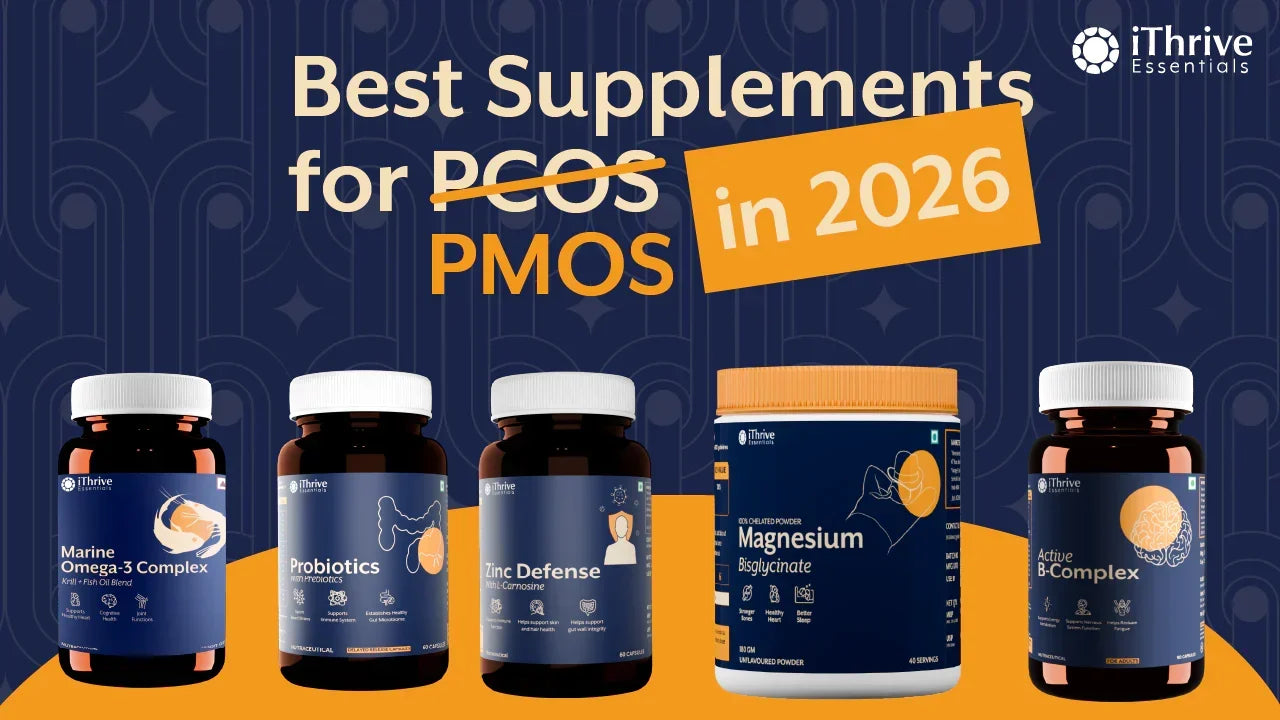
Best Vitamins and Supplements for PCOS in 2026: A Complete Guide
What are PCOS and PMOS?
PCOS, namely Polycystic Ovary Syndrome, now referred to as PMOS in India, is one of the most common hormonal and metabolic disorders affecting women of reproductive age. While irregular periods are mostly the symptom that gets the most attention, PCOS is actually a much broader condition that involves insulin resistance, chronic inflammation, elevated androgen levels, disrupted ovulation, as well as altered metabolic function.
This is also exactly why two women with PCOS can have entirely different experiences. Like one might struggle primarily with weight gain as well as insulin resistance, while another might experience acne, hair thinning, irregular cycles, fertility challenges, or at times even persistent fatigue.
Over the past 6 years at iThrive, our in-house scientist and Head of Formulations has repeatedly observed that many women focus entirely on symptom management while unintentionally overlooking the nutritional foundations that influence factors such as hormone production, insulin signaling, inflammation, along with ovarian function. While supplements are not a cure for PCOS, the right nutrients can potentially support many of the biological systems that become disrupted in the condition.
Introduction
If you search for PCOS supplements online, you will find hundreds of recommendations. In such cases inositol, magnesium, zinc, vitamin D, probiotics, omega 3s, CoQ10 and dozens of other nutrients are most of the times promoted as essential.
There was a client of Suyash who kept mentioning if her friend who had PCOS can take the exact supplements she was advised to and Suyash had to legit explain to her that not every woman with PCOS needs the same supplement strategy.
A woman dealing with insulin resistance might need different support as compared to someone who focuses on fertility. Then a woman experiencing hair loss and elevated testosterone might benefit from a completely different nutritional approach than someone who's struggling with inflammation and fatigue.
The goal therefore should never be collecting supplements. The goal rather should always be understanding which nutrients influence the underlying mechanisms driving PCOS.
Why nutrient deficiencies are so common in PCOS

One of the lesser discussed aspects of PCOS is that nutritional deficiencies frequently coexist alongside hormonal imbalances.
Insulin resistance can entirely alter utilization of nutrients which makes it worse for the ones suffering with PCOS now PMOS. Chronic inflammation maximises oxidative stress and nutrient demands which has to be compensated with potential supplement. Lastly, restrictive diets often result in inadequate intake of important vitamins and minerals. Additionally, poor gut health can impair absorption and influence hormone metabolism.
This then develops a cycle where nutritional deficiencies worsen the very symptoms women are trying to solve. This is truly why so much evidence based PCOS protocols begin right with foundational nutrients before moving toward more specialized interventions. This is why this blog will make a clear path for you as you go throughout this one. You will have a clear printable table which can help you with the supplements you should take, when you should take, and the reason for the same.
The core PCOS supplement stack
Active B Complex: The foundation for insulin resistance and hormonal balance
If there has to be a single supplement category that addresses multiple aspects of PCOS simultaneously, it is none other than the B vitamin family.
Myo inositol has become one of the highly researched nutrients in PCOS because of its role in insulin signaling. It is often mentioned by Suyash that improved insulin sensitivity can help in restoring ovulation, supporting cycle regularity, and reducing androgen production.
You should always consider buying Active B Complex as it goes beyond standard B vitamins by combining Myo Inositol with Quatrefolic® methylfolate, active B6, methylcobalamin B12, choline, and other metabolically important nutrients.
For women with PCOS, this matters a lot because insulin resistance, methylation pathways, fertility, progesterone production, and liver based hormone clearance are all interconnected systems.
Who might benefit the most?
Women experiencing irregular cycles, elevated androgens, poor energy and fatigue, insulin resistance, and in fact the ones with fertility concerns.
Magnesium: The missing mineral in most PCOS protocols
A surprising number of women with PCOS have inadequate magnesium intake. Magnesium participates in more than 300 enzymatic reactions, many of which have a direct influence with insulin receptor function, glucose metabolism, stress regulation, and sleep quality.
Is magnesium important for PCOS?
Yes absolutely, insulin signaling depends majorly on availability of magnesium. Deficiency has been associated with worsening insulin resistance, increased inflammation, poor sleep quality, and higher cortisol levels.
The challenge is that not all forms absorb equally well. Magnesium oxide, which is commonly used in inexpensive supplements, has absorption rates as low as 4%. Magnesium bisglycinate is significantly better absorbed and tends to be gentler on the part of digestion.
Women who experience PMS, poor sleep, anxiety, muscle tension, or blood sugar fluctuations should take Magnesium Bisglycinate for witnessing great benefits.
Does zinc help with PCOS?
One of the hallmark features of PCOS is elevated androgen activity. This can altogether contribute to acne, unwanted facial hair growth, and hair thinning. There zinc acts as a cofactor for several hormone related enzymes and helps in regulating androgen metabolism. So do consider having zinc defense for experiencing better skin.
Will PCOS cause hair loss?
Unfortunately, I have to say the answer is yes. Many women with PCOS experience androgenic hair thinning due to increased sensitivity to DHT, which is a more potent form of testosterone.
This is mostly where zinc becomes particularly interesting. It has also been recommended by our in-house scientist and head of formulations that zinc helps in supporting normal 5 alpha reductase activity, the enzyme involved in converting testosterone into DHT. The inclusion of L Carnosine further adds another layer of support because glycation and oxidative stress are increasingly recognized contributors to metabolic dysfunction in PCOS.
Does spearmint tea actually help PCOS?

Among herbal interventions, spearmint remains one of the most interesting. It has been demonstrated that regular spearmint consumption might reduce free testosterone levels in women with PCOS. This doesn't mean spearmint is a cure, no we would never state that. However, it might offer supportive benefits for women dealing with androgen related symptoms than PCOS.
Our Detox Tea Blend combines spearmint with chicory root, dandelion root, and also hibiscus. Together, these ingredients support various functions like hormonal balance, gut health, liver function, and inflammatory regulation.
Unlike many commercial teas, it is caffeine free, which further makes it suitable for women who are already dealing with elevated stress hormones.
What is the best vitamin D level for PCOS?
Vitamin D deficiency is remarkably common in women with PCOS. Vitamin D functions more like a hormone than a vitamin. Receptors for vitamin D are found throughout reproductive tissues, including the ovaries.
As we claim with science backed explanations, adequate vitamin D status may support mood regulation, insulin sensitivity, ovulation, and menstrual regularity. While optimal levels vary, many of the practitioners aim for serum 25 OH Vitamin D levels between 40 and 60 ng/mL but because vitamin D is fat soluble, absorption matters a lot.
Therefore, liquid vitamin D3 combined with K2 and delivered in MCT oil offers a practical strategy for improving bioavailability.
Should women with PCOS take omega-3 supplements?
Chronic low grade inflammation is increasingly identified as one of the central drivers of PCOS. Omega 3 fatty acids, and particularly EPA, plays a critical role in regulating inflammatory pathways. Marine Omega-3 is beneficial for triglyceride balance, cardiovascular health, insulin sensitivity and mood regulation.
For women with PCOS who also have metabolic syndrome, elevated triglycerides, or persistent inflammation, Marine Omega 3 supplementation can be a valuable addition to a broader protocol.
Why gut health deserves more attention in PCOS
The conversation around PCOS often focuses exclusively on hormones. This is one question that Suyash gets almost every time and here is the explanation that he has that hormones and the gut microbiome are deeply interconnected. The gut contains bacterial communities involved in estrogen metabolism, inflammatory regulation, insulin sensitivity, and nutrient absorption. So when microbial diversity declines, hormone regulation becomes more difficult. This is exactly why probiotics and prebiotics are becoming increasingly important in modern PCOS protocols. So, rather than viewing probiotics as digestive supplements, many practitioners now view them as metabolic and hormonal support tools.
PCOS supplements timing guide

Can PCOS women get pregnant?
Yes of course, many women with PCOS successfully conceive and have healthy pregnancies. However, fertility challenges can occur at times because PCOS often affects ovulation.
Nutrients such as Myo Inositol, methylfolate, CoQ10, omega 3s, vitamin D, and magnesium are frequently included in fertility focused protocols because they support ovarian function, egg quality, metabolic health, and hormonal regulation.
Will PCOS affect pregnancy?
PCOS can increase the risk of complications such as gestational diabetes and pregnancy related hypertension. This is the only reason why addressing metabolic health before conception is proven to be important.
Key Takeaway
One thing that you have to always keep in consideration is that the most effective PCOS supplement strategy is rarely about finding a single miracle nutrient. PCOS is a complex condition and each of the above mentioned systems has equal interconnectedness with each other. Over 6 years of working with thousands of customers, our team here at iThrive has consistently observed that women tend to see the greatest improvements when they particularly focus on building strong nutritional foundations rather than chasing quick fixes. In such a case a well designed protocol that includes bioavailable forms of magnesium, zinc, vitamin D, probiotics, and omega 3s can definitely support many of the pathways that are involved in PCOS. So finally there's a note from our iThrive team that your goal should never be to manage symptoms, it should always be to look deeper into what is driving your case and what can be done to feel better and reverse the same.

Written by Mugdha Pradhan

Leave a comment
This site is protected by hCaptcha and the hCaptcha Privacy Policy and Terms of Service apply.