
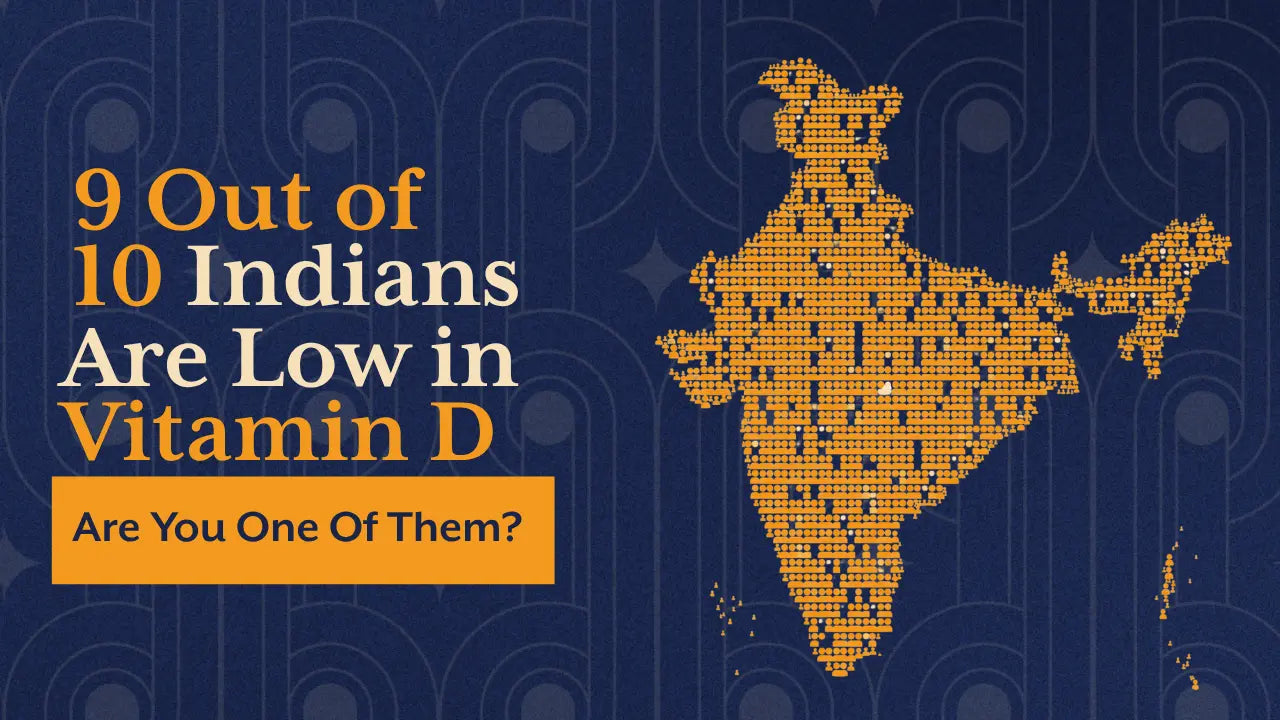
You live in one of the sunniest countries on earth, so why is your vitamin D still low?
Introduction
A few years back, Suyash (head of formulation) was sitting across from a client, a 34-year-old marketing manager from Pune. She wasn't sick in any obvious way like a dramatic diagnosis. But she was exhausted all the time, her knees ached for no reason, and she kept catching every cold that went around her office, and she'd been feeling oddly low for a couple of months. Her doctor had run some tests and, almost as a footnote, mentioned her vitamin D was critically low.

She laughed it off when she told Suyash. But I live in India. How am I low on vitamin D?
Suyash had heard this before. He'd hear it hundreds of times after that too. And every single time, the answer stayed the same because sunshine and vitamin D absorption are not the same thing.
That conversation is part of why, when he was formulating iThrive's supplements back in 2021, vitamin D3 with K2 was one of the first things he worked on. He'd seen what this deficiency does to people. He'd also seen how poorly most supplements actually address it.
But before we get there, let's actually talk about why this is happening to so many of us.
We have sunshine. So why do we have a Vitamin D deficiency epidemic?

Here's the uncomfortable truth — studies suggest over 70% of urban Indians are deficient or insufficient in vitamin D. That's not a small number, that's most of us.
And NO, it's not because we don't go outside. It's because of a combination of factors that most people simply don't know about.
Melanin works against you here.
The darker your skin tone, the more melanin you have and melanin blocks UVB radiation. UVB is the specific wavelength your skin needs to synthesise vitamin D. So if you have a slightly deeper skin tone (which majority of us Indians do), you actually need significantly more sun exposure than someone with lighter skin to produce the same amount of vitamin D. And no that's not a flaw, it's just biology.
Timing matters more than you think.
Your skin can only make vitamin D when the sun is high enough in the sky that is during its peak time roughly between 11 AM and 2 PM. That's exactly when most of us are indoors, in offices, or actively avoiding the sun because it's too hot.
Air pollution is quietly blocking you.
If you're in Mumbai, Pune, Delhi, or Bengaluru, the pollution layer in the air literally filters out UVB rays before they even reach your skin. So even if you're outside at the right time, the smog is doing a number on your vitamin D synthesis.
Your diet probably isn't helping.
Most vitamin D rich foods are animal-based like fatty fish, egg yolks, organ meats, liver. So just in case if you're vegetarian, your dietary intake of vitamin D in food is either zero or close to zero.
What Vitamin D deficiency actually feels like

This is where it gets entirely personal because vitamin D deficiency symptoms don't ever announce themselves dramatically. They creep in slowly, and they're easy to write off as stress, aging, or in fact just being busy.
Here's what low vitamin D commonly looks like:
-
Fatigue that doesn't go away
You sleep enough but still feel drained. If this sounds like you, our blog on nutrient deficiencies hiding behind constant fatigue is worth reading. -
Bone or joint pain
Low-grade aches, especially in the knees, hips, or lower back. -
Getting sick constantly
Vitamin D plays a direct role in immune function and deficiency tanks it. -
Low mood or mild depression
Vitamin D receptors exist throughout your brain, so when levels drop, so can your mood. -
Muscle weakness
Particularly noticeable when climbing stairs or doing physical work. -
Hair thinning
Very less always talked about, but low vitamin D is linked to hair follicle health.
You want to know the most tricky part? These symptoms overlap with a dozen other things. Which is exactly why vitamin D deficiency goes undetected for so long in so many of us.
Why most vitamin D supplements don't actually work

Okay, so you've gotten your test done, your vitamin D is low, and you've picked up a bottle of vitamin D3 tablets from a nearby pharmacy store. You now think the problem is solved, right?
Not quite.
Here's what most brands won't ever tell you, vitamin D3 is a fat-soluble vitamin. That means it needs dietary fat present to be absorbed. If you're taking a dry tablet or capsule on an empty stomach, a significant chunk of it is passing right through you without being absorbed.
That's just one problem.
Problem two is bigger. When you supplement with vitamin D3, your body starts absorbing significantly more calcium from food. That calcium needs to go somewhere. Ideally, it goes to your bones and teeth but without Vitamin K2, it doesn't always get that direction and it can also end up in soft tissues and arterial walls instead. It again is not great for long-term heart health.
Why Suyash formulated D3 + K2 the way he did
When Suyash was developing iThrive's vitamin D3 K2 formula, he kept thinking about bioavailability first. According to him, the supplement that looks great on a label but doesn't absorb well is just expensive and useless. He'd seen enough of those already.
So the iThrive Liquid Vitamin D3 + K2 Drops were built around a few non-negotiables:
Liquid format in MCT oil
D3 and K2 are fat-soluble, so they need fat to absorb. Suspending them in MCT oil means the fat carrier is already there, whether or not you've eaten.
Vegan D3 from lichen
Not fish-derived, not wool-derived. The same vitamin D3 your body produces from sunlight, just sourced from a plant. 100% cruelty-free and suitable for vegetarians and vegans.
K2 as MK-7
MK-7 has a significantly longer half-life in the body than the synthetic K1 or MK-4 that are found in cheaper formulas. It stays active longer, meaning calcium gets properly directed to your bones throughout the day, not just for a couple of hours.
No fillers, no unnecessary additives, 3rd party lab-tested for purity and potency. That's the iThrive standard and it's been that way since we started in 2021, and lakhs of people now trust us for their daily supplements because of it.
How to take it and what to pair it with
One drop under the tongue or added to any beverage, ideally with a meal that contains some fat. If you're deficient (vitamin D levels below 30 ng/dL), Suyash recommends 10 drops daily for about 2 months to bring levels up, then scaling down to 2–3 drops for maintenance.
The most important co-supplement? It has to be none other than Magnesium Bisglycinate. Most people don't know this, but magnesium is required to activate vitamin D in the body. Without adequate magnesium, even a well-absorbed vitamin D supplement can't do its job properly. We've also written about this in our magnesium deficiency blog, worth a read if you haven't already.
So, what should you actually do?

Start with a blood test. Then supplement smartly with a vitamin D3 formula that actually absorbs, paired with K2 to make sure that calcium ends up where it belongs.
That client of Suyash's? 3 months after she started on D3 + K2 drops and fixed her magnesium too, her energy was back. Her joints stopped aching and she stopped catching every cold. Same person, same busy life, same sun she'd always lived under. Just finally giving her body what it needed.
Key Takeaway
Living in one of the sunniest countries in the world does not automatically protect you from vitamin D deficiency. Factors like skin tone, indoor lifestyles, pollution, timing of sun exposure, and poor absorption can all contribute to low levels. The good news is that deficiency is measurable and correctable. Start by testing your vitamin D levels, then choose a bioavailable Vitamin D3 + K2 supplement and ensure your magnesium intake is adequate. Small daily changes today can have a significant impact on your energy, immunity, bone health, and overall wellbeing in the months ahead.

Written by Mugdha Pradhan
%20was%20sitting%20across%20from%20a%20client,%20a%2034-year-old%20marketing%20manager%20from%20Pune.%20She%20wasn't%20sick%20in%20any%20obvious%20way%20like%20a%20dramatic%20diagnosis...)
Leave a comment
This site is protected by hCaptcha and the hCaptcha Privacy Policy and Terms of Service apply.