
The 3 Nutrients That Control Thyroid Hormone Activation And Why Dosage Isn’t Enough
Introduction
When people think about thyroid health, they usually think about production whether the gland is making enough hormone. But production is only the first step in a much larger physiological process. Hormones must be transported, converted, activated, and utilised at the cellular level. Without these downstream steps, even perfectly normal hormone production can fail to generate a normal metabolic response.
This distinction is critical. Many individuals experience persistent fatigue, weight changes, cold intolerance, or metabolic slowing despite laboratory values that appear “within range.” What often goes unnoticed is that thyroid hormone activity depends less on how much hormone is produced and more on how effectively it is activated inside tissues.
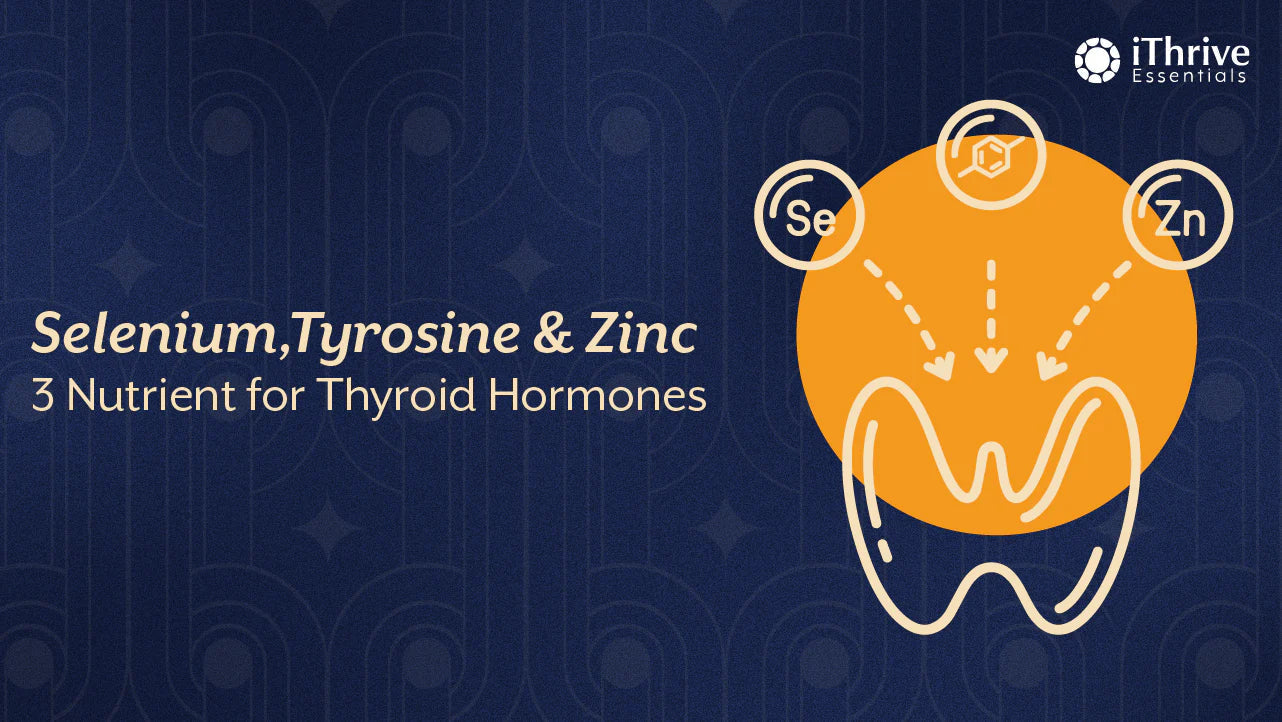
Activation is a biochemical process. It depends on enzyme systems, cellular signalling, mitochondrial energy status, and nutrient availability. And among all supporting factors, three nutrients play especially central roles: selenium, zinc, and tyrosine.
These nutrients do not simply “support thyroid health.” They regulate hormone conversion, receptor sensitivity, and molecular signalling. Yet most supplements treat them as isolated ingredients, measured only by dosage.
But biology does not respond to dose alone. It responds to bioavailability, transport, enzymatic function, and metabolic context.
Understanding this difference explains why so many thyroid supplements fail to produce meaningful physiological change.
Section 1: Thyroid Hormone Activation Is a Multi-Step Biological Process
Thyroid physiology is often simplified into production and circulation. In reality, hormone function involves multiple regulatory layers.
The thyroid gland produces primarily thyroxine (T4), which is largely inactive. For metabolism to respond, T4 must be converted into triiodothyronine (T3), the biologically active form that interacts with nuclear receptors inside cells.
This conversion occurs primarily in peripheral tissues - liver, kidneys, skeletal muscle, and brain through enzymes known as deiodinases.
Once T3 is produced, it must:
- Enter target cells
- Bind to nuclear receptors
- Influence gene transcription
- Modify mitochondrial activity
- Adjust metabolic rate
Each of these steps depends on nutrient-dependent biochemical reactions.
If any part of this pathway becomes inefficient, the result can resemble thyroid dysfunction even when circulating hormone levels remain normal.
This is why focusing only on hormone production or dosage of nutrients is an incomplete strategy.
Hormone activation is an enzymatic and cellular event.
Section 2: Selenium: The Enzyme Regulator of Hormone Conversion
Selenium is essential because it forms the functional core of deiodinase enzymes. These enzymes physically remove iodine atoms from T4, converting it into active T3.
Without adequate selenium, this conversion slows or becomes inefficient. The body may produce sufficient T4, but tissues receive less active hormone.
This creates a state of functional hormone deficiency despite adequate production.
Beyond conversion, selenium also protects thyroid tissue from oxidative stress. Hormone synthesis generates reactive oxygen species, making the thyroid one of the most oxidation-intensive organs in the body. Selenium-dependent antioxidant enzymes protect the gland from inflammatory damage.
When selenium is insufficient:
- T4 to T3 conversion declines
- Oxidative stress increases
- Inflammatory signalling rises
- Hormone activation becomes inconsistent
Importantly, the effectiveness of selenium depends heavily on its chemical form and absorption efficiency. Poorly absorbed forms may provide minimal enzymatic support despite high labelled dosage.
This illustrates a recurring principle: nutrient function depends on utilisation, not intake alone.

Section 3: Zinc: The Signal Amplifier of Thyroid Hormone Action
While selenium supports hormone conversion, zinc influences what happens after activation.
Zinc plays critical roles in:
- Thyroid receptor structure and binding
- Hormone signalling efficiency
- Hypothalamic-pituitary regulation
- Immune modulation within thyroid tissue
Even when T3 is available, cellular response depends on receptor sensitivity. Zinc stabilises receptor proteins and supports the transcriptional machinery that allows hormones to influence metabolism.
Without sufficient zinc, hormone signalling weakens. Cells receive the signal but respond incompletely.
Zinc deficiency has also been associated with impaired appetite regulation, immune dysregulation, and altered inflammatory signalling, all factors that can indirectly affect thyroid physiology.
Again, dosage alone does not determine impact. Zinc must be delivered in forms that cross intestinal barriers efficiently and reach intracellular compartments where receptors operate.

Section 4: Tyrosine: The Structural Precursor of Hormone Synthesis
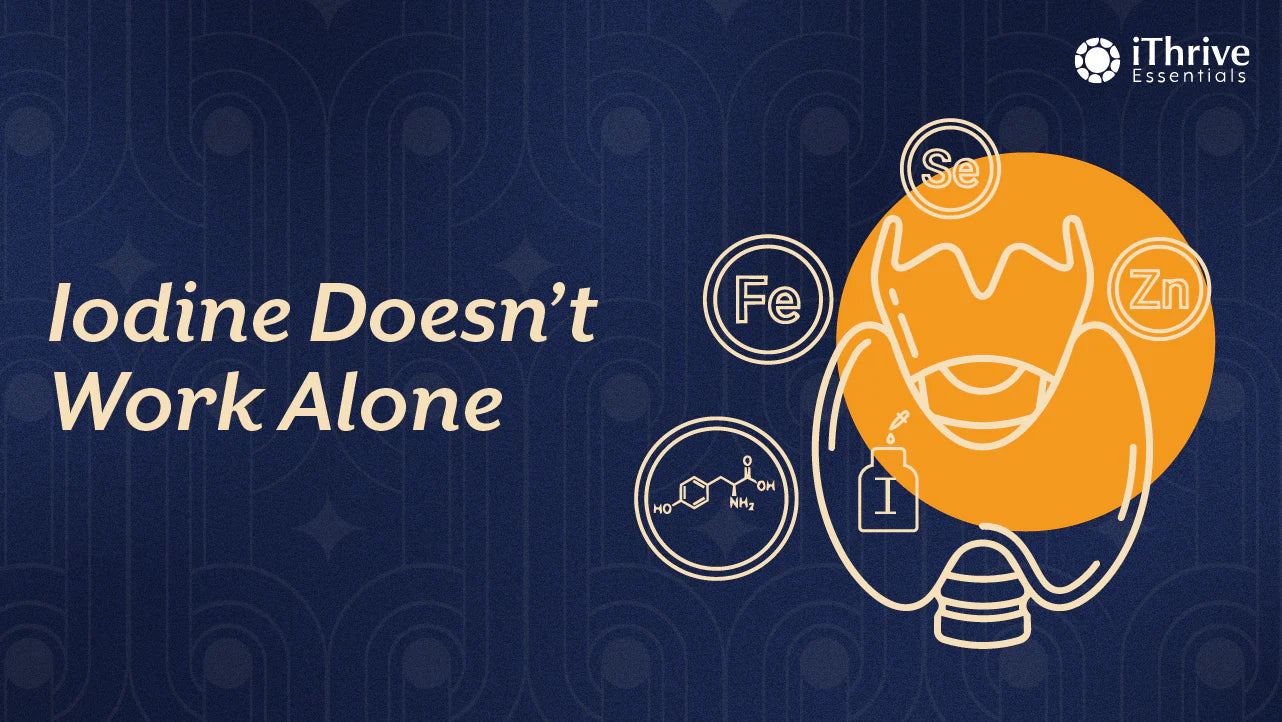
Tyrosine is the amino acid backbone from which thyroid hormones are built. Iodine binds to tyrosine residues within thyroglobulin to form T4 and T3.
Without adequate tyrosine availability, hormone synthesis cannot proceed efficiently, regardless of iodine supply.
But tyrosine’s role extends beyond structural function. It also supports neurotransmitter production, including dopamine and norepinephrine, which influence hypothalamic-pituitary signalling.
This means tyrosine indirectly affects the regulatory system controlling thyroid output.
When tyrosine supply is limited, the body may prioritise neurotransmitter production or hormone synthesis depending on metabolic demand. This competition can influence overall endocrine balance.
Thus, tyrosine availability must be sufficient and metabolically accessible, not merely consumed.
Section 5: Why Dosage Alone Does Not Predict Biological Effect
A supplement label shows intake. Biology responds to utilisation.
Several factors determine whether a nutrient influences thyroid activation:
- Absorption efficiency
- Transport into tissues
- Enzymatic incorporation
- Cellular uptake
- Metabolic demand
- Co-factor availability
This explains why increasing dosage often produces diminishing returns.
If transport systems are saturated, enzymes lack cofactors, or absorption is limited, higher intake does not translate into greater activity.
This same principle appears across metabolic physiology. As discussed in “Toxin Overload: The Hidden Reason Behind Stubborn Weight and Low Energy,” physiological systems often protect themselves by limiting metabolic activity when internal stress rises. Nutrient utilisation follows similar regulatory patterns.
The body does not respond linearly to input.
It responds adaptively to context.
Section 6: Nutrient Synergy Determines Hormone Activation Efficiency
Thyroid physiology operates through interconnected pathways. Selenium enables conversion, zinc enables signalling, and tyrosine enables synthesis. Each depends on the others to produce coordinated metabolic output.
Deficiency or inefficiency in any one nutrient can limit the entire system.
This is why isolated supplementation often produces partial or inconsistent results. Biological pathways function as networks, not independent channels.
Modern formulation science therefore focuses on pathway-based design delivering nutrients in forms and ratios that reflect physiological relationships.
This system's approach is central to advanced supplementation strategies, particularly those prioritising absorption, transport, and cellular targeting.
It is also why precision nutrient design emphasises biochemical compatibility rather than ingredient quantity alone.
Section 7: Bioavailability: The Missing Variable in Thyroid Supplement Design
Bioavailability determines how much of a nutrient reaches the site where it performs biological work.
This depends on:
- Molecular form
- Chelation or binding structure
- Digestive stability
- Transport mechanisms
- Cellular uptake efficiency
Two supplements with identical dosages can produce dramatically different physiological effects if their absorption or transport differs.
The importance of metabolic targeting has been explored in “Why We Added Inositol, Choline and TMG to Our New B-Complex Supplement,” which explains how modern formulations support specific biochemical pathways rather than delivering isolated nutrients.
The same principle applies to thyroid support.
Activation depends not just on presence but on delivery, integration, and utilisation.

Section 8: Precision Nutrient Formulation and Thyroid Physiology
Advanced supplement design focuses on supporting physiological pathways rather than simply increasing intake.
This includes:
- Activated nutrient forms
- Co-factor pairing
- Cellular delivery optimisation
- Balanced mineral interactions
- Targeted metabolic support
This philosophy underlies formulation approaches used by iThrive Essentials, where nutrient delivery is structured around biological function rather than ingredient quantity.
Such approaches recognise that thyroid hormone activation is not controlled by a single nutrient, single dose, or single mechanism.
It is governed by integrated biochemical regulation.
Key Takeaway
Thyroid hormone activation is not determined by how much hormone is produced, nor by how much of a single nutrient is consumed. It is controlled by an intricate biochemical network that governs synthesis, conversion, signalling, and cellular response. Selenium enables enzymatic activation, zinc enables receptor-level communication, and tyrosine provides structural and regulatory foundations for hormone production.
Yet these nutrients influence physiology only when they are absorbed efficiently, delivered to target tissues, and integrated into metabolic pathways. This is why dosage alone cannot restore thyroid function. Biological systems respond to availability, synergy, and cellular utilisation not simply intake. Effective thyroid support therefore requires precision nutrient design that reflects how the body actually regulates metabolism. Understanding this distinction shifts the focus from supplementation quantity to biochemical functionality, the true determinant of hormone activation.


Leave a comment
This site is protected by hCaptcha and the hCaptcha Privacy Policy and Terms of Service apply.