
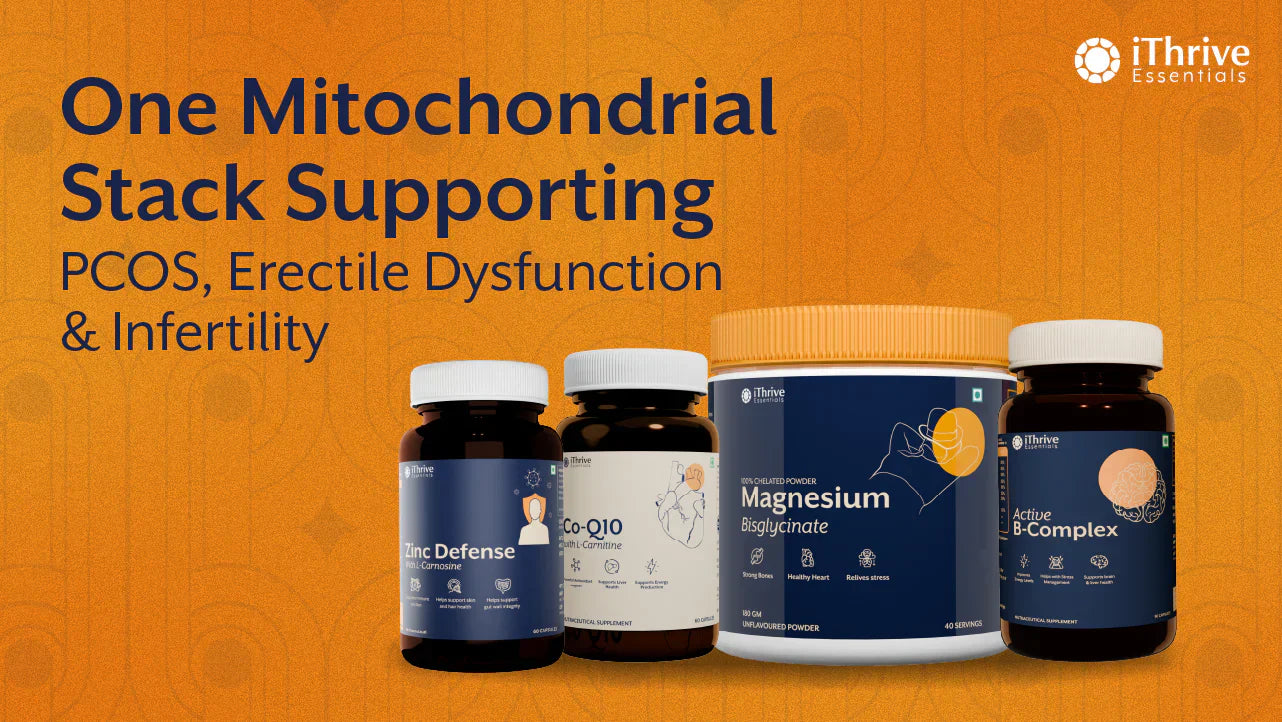
One Mitochondrial Stack, Three Outcomes: How Targeted Nutrients Support PCOS, ED & Infertility Together
Introduction
At first glance, polycystic ovary syndrome (PCOS), erectile dysfunction (ED), and infertility appear to belong to entirely separate clinical categories. PCOS is typically discussed within women’s endocrine health, erectile dysfunction within male sexual health, and infertility as a reproductive concern affecting both sexes.
However, when these conditions are examined through the lens of cellular physiology, a common metabolic denominator often emerges: mitochondrial dysfunction.
Mitochondria are the energy-generating structures within our cells. They convert nutrients into ATP, the biochemical energy currency required for nearly every biological function. Reproductive tissues are particularly energy dependent. Hormone synthesis, follicular development, sperm motility, vascular dilation, and cellular signalling all rely heavily on efficient mitochondrial energy production.
When mitochondrial performance declines, reproductive physiology can begin to malfunction in subtle but measurable ways. In women with PCOS, mitochondrial inefficiency contributes to impaired ovarian function and metabolic dysregulation. In men experiencing erectile dysfunction, insufficient cellular energy within endothelial cells can disrupt nitric oxide signalling and vascular relaxation. In both men and women struggling with infertility, mitochondrial stress may compromise gamete quality, fertilisation capacity, and early embryonic development.
This shared metabolic foundation explains why targeted nutritional strategies aimed at improving mitochondrial function can often produce benefits across multiple reproductive conditions simultaneously.
Rather than addressing PCOS, erectile dysfunction, and infertility as isolated disorders, it can be more effective to examine the core cellular pathways that support reproductive physiology. Nutrients that enhance mitochondrial energy production, protect against oxidative stress, and stabilise metabolic signalling form what could be described as a mitochondrial support stack.
Understanding how these nutrients interact with reproductive biology allows us to see how a single nutritional framework can support three seemingly different outcomes.
The Mitochondrial Link Between Hormones, Vascular Function, and Fertility
Reproductive health is fundamentally an energy-dependent process. Hormone-producing glands, reproductive organs, and vascular tissues rely on mitochondria to generate the ATP necessary for signalling and cellular activity.
Three key biological systems connect PCOS, erectile dysfunction, and infertility:
1. Hormone synthesis
Steroid hormones such as testosterone, progesterone, and estrogen are synthesised through mitochondrial enzyme pathways. When mitochondrial efficiency declines, hormonal signalling may become disrupted.
2. Cellular energy for reproductive tissues
Ovarian follicles and sperm cells are metabolically demanding structures. Both require a steady supply of ATP to mature and function correctly.
3. Vascular signalling and nitric oxide production
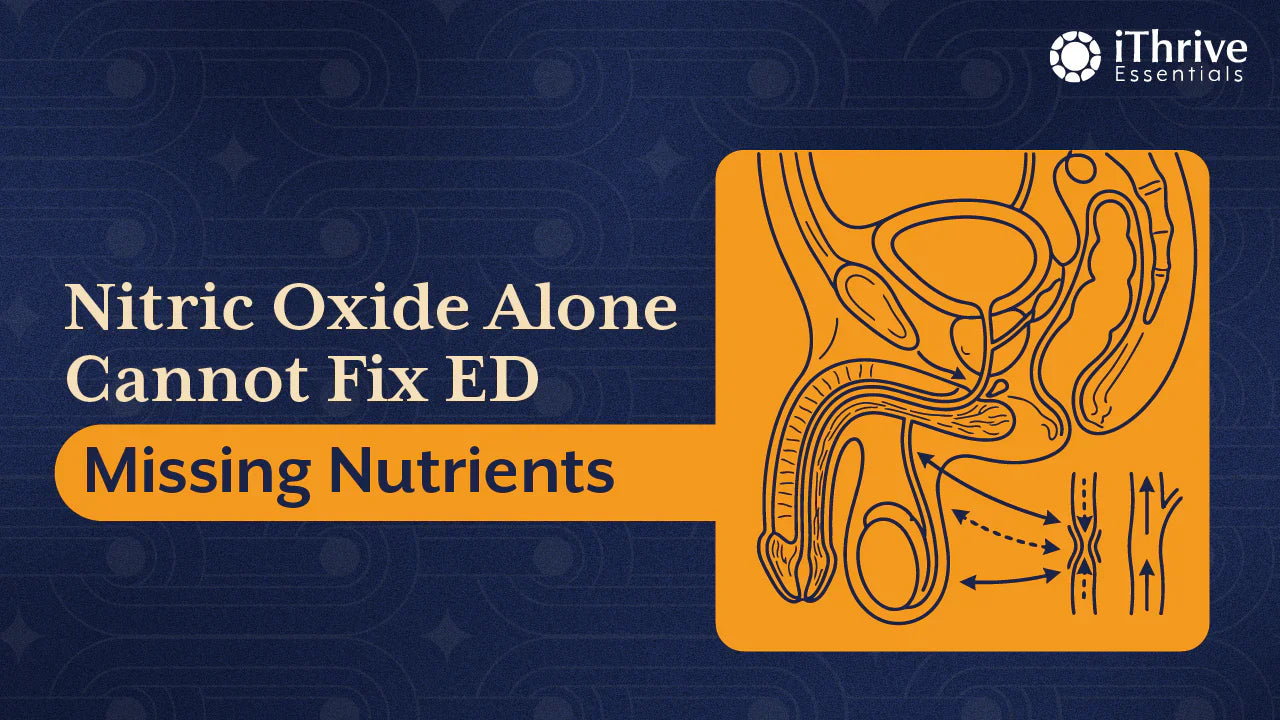
Erectile function and reproductive organ perfusion depend on nitric oxide signalling within endothelial cells. This signalling process relies heavily on mitochondrial energy availability.
When mitochondrial performance becomes compromised, the downstream effects may include:
-
Irregular ovulation in PCOS
-
Reduced sperm motility
-
Poor egg quality
-
Impaired erectile response
-
Reduced reproductive hormone signalling
For this reason, targeted nutrients that support mitochondrial pathways can influence multiple reproductive outcomes simultaneously.

The Mitochondrial Nutrient Stack
Several nutrients play particularly important roles in mitochondrial metabolism and reproductive physiology. When combined strategically, they create a metabolic environment that supports hormonal balance, vascular function, and gamete health.
1. Coenzyme Q10: Supporting Cellular Energy Production
One of the most important mitochondrial nutrients is Coenzyme Q10, commonly abbreviated as CoQ10.
CoQ10 functions as an electron carrier within the electron transport chain, the mitochondrial process responsible for ATP production. Without adequate CoQ10, the efficiency of energy generation declines.
This becomes especially relevant in reproductive tissues.
In women with PCOS, mitochondrial dysfunction within ovarian cells can contribute to impaired follicular development and reduced oocyte quality. In men, sperm cells rely on mitochondrial ATP to power the flagellar movement necessary for motility.
Research has demonstrated that adequate CoQ10 levels support:
-
Improved mitochondrial energy output
-
Protection against oxidative damage
-
Enhanced sperm motility
-
Improved egg quality in assisted reproductive settings
Because reproductive tissues are highly susceptible to oxidative stress, the antioxidant function of CoQ10 may also protect mitochondrial membranes and DNA.
Supplements such as those available through iThrive Essentials formulations that include CoQ10 are often designed to support mitochondrial metabolism and cellular energy production.
2. Magnesium: The Mineral Behind ATP Activation
While ATP is often referred to as the body’s energy molecule, it is rarely biologically active on its own. In most metabolic reactions, ATP must bind to Magnesium to become functionally usable.
Magnesium acts as a cofactor in over 300 enzymatic reactions, many of which occur within mitochondrial energy pathways.
In reproductive physiology, magnesium contributes to:
-
ATP stabilisation and utilisation
-
Hormonal signalling pathways
-
Nitric oxide production
-
Smooth muscle relaxation within blood vessels
This last function is particularly important in the context of erectile dysfunction. Adequate magnesium levels support vascular relaxation and endothelial function, both of which are necessary for healthy erectile responses.
Magnesium also plays a role in insulin signalling, which is relevant in PCOS where insulin resistance frequently disrupts ovarian hormone balance.
Magnesium supplementation, including products formulated by iThrive Essentials, can therefore support both metabolic and reproductive health.
3. B Vitamins: Driving Mitochondrial Enzyme Systems
The mitochondrial energy cycle relies heavily on enzymes that require B vitamin cofactors.
Key B vitamins involved in mitochondrial metabolism include:
-
Vitamin B1 (thiamine)
-
Vitamin B2 (riboflavin)
-
Vitamin B3 (niacin)
-
Vitamin B5 (pantothenic acid)
-
Vitamin B12
-
Folate
These vitamins participate in the Krebs cycle, the metabolic pathway that converts nutrients into electron carriers used to generate ATP.
Deficiencies in B vitamins can impair:
-
Energy production
-
Cellular repair mechanisms
-
DNA synthesis in reproductive cells
-
Hormonal signalling pathways
Because both sperm cells and developing oocytes require efficient DNA synthesis and mitochondrial energy production, adequate B vitamin intake becomes particularly important for fertility outcomes.
Balanced formulations such as iThrive Essentials B-Complex products aim to provide activated forms of these vitamins to support metabolic pathways more efficiently.
4. Zinc: Stabilising Hormone Signalling
Another nutrient with strong relevance to reproductive health is Zinc.
Zinc plays several roles in hormone metabolism and reproductive physiology:
-
Stabilisation of androgen receptors
-
Support for testosterone production
-
Protection against oxidative stress
-
Contribution to sperm structure and motility
In men, zinc deficiency has been associated with reduced testosterone levels and poor sperm parameters. In women, zinc contributes to ovarian hormone signalling and immune balance.
Because hormone receptors rely on structural integrity to bind hormones effectively, adequate zinc intake helps ensure that endocrine signals are properly translated into cellular responses.
5. Selenium: Protecting Reproductive Cells from Oxidative Stress
Finally, Selenium plays a critical antioxidant role in reproductive physiology.
Selenium is a key component of selenoproteins, enzymes that protect cells from oxidative damage. This protection is particularly important for sperm cells, whose membranes contain high levels of polyunsaturated fatty acids that are vulnerable to oxidative stress.
Selenium supports:
-
Antioxidant enzyme activity
-
Sperm structural integrity
-
Thyroid hormone metabolism
-
Protection of ovarian cells
Because oxidative stress can damage mitochondrial DNA and impair gamete quality, adequate selenium intake may help preserve reproductive function.

Why a Pathway-Based Nutrient Stack Matters
Traditional supplementation strategies often focus on individual nutrients in isolation. However, mitochondrial metabolism is a networked system where nutrients interact with one another.
For example:
-
CoQ10 improves electron transport chain efficiency
-
B vitamins drive enzymatic reactions within the Krebs cycle
-
Magnesium activates ATP molecules
-
Zinc stabilises hormone receptor signalling
-
Selenium protects mitochondrial structures from oxidative damage
When these nutrients work together, they support the entire metabolic infrastructure that reproductive physiology depends upon.
This pathway-based approach helps explain why a targeted mitochondrial nutrient stack can influence multiple reproductive conditions simultaneously.

Key Takeaway
Although Polycystic Ovary Syndrome, Erectile Dysfunction, and Infertility appear to affect different aspects of reproductive health, they often share a common metabolic foundation: mitochondrial efficiency. Reproductive tissues require large amounts of cellular energy for hormone synthesis, vascular signalling, and gamete development. When mitochondrial performance declines, these processes can become compromised, contributing to hormonal imbalance, impaired blood flow, and reduced reproductive capacity. Nutrients that support mitochondrial pathways such as Coenzyme Q10, Magnesium, and B-vitamins help restore the biochemical environment required for healthy cellular function. By targeting the underlying energy systems that drive reproductive physiology, a mitochondrial nutrient strategy can support multiple outcomes simultaneously, rather than addressing each condition in isolation.

,%20erectile%20dysfunction%20(ED),%20and%20infertility%20appear%20to%20belong%20to%20entirely%20separate%20clinical%20categories.%20PCOS%20is%20typically%20discussed%20wit...)
Leave a comment
This site is protected by hCaptcha and the hCaptcha Privacy Policy and Terms of Service apply.