

Beyond Myo Inositol: What a Truly Mitochondria Targeted PCOS Supplement Should Contain
Introduction
For years, myo inositol has dominated conversations around Polycystic Ovary Syndrome. It has earned its place in clinical discussions because of its role in ovarian signalling and metabolic regulation. Yet an important question remains largely unasked: is ovarian signalling the root issue, or is it the surface expression of something deeper?
PCOS is not merely a hormonal condition. It is a cellular energy disorder. The ovary is one of the most metabolically active organs in the female body. Follicular maturation, steroidogenesis, and ovulation are energy intensive processes that rely on efficient mitochondrial respiration. When mitochondrial function declines, the consequences are not limited to fatigue. They manifest as disrupted follicular development, altered androgen production, and impaired ovulatory rhythms.
Myo inositol supports signalling pathways. But signalling without energy is like switching on a system that lacks electricity. A truly effective PCOS supplement must move beyond signalling support and address mitochondrial efficiency, redox balance, nutrient activation, and cofactor integrity. Formulation is not about adding more ingredients. It is about assembling a biochemical ecosystem.
This blog explores what a mitochondria targeted PCOS formulation should actually contain and why quality, activation state, and nutrient pairing determine biological impact.
Myo Inositol Is a Signalling Molecule, Not an Energy Molecule
Myo inositol functions as a secondary messenger in ovarian cells. It supports follicle stimulating hormone signalling and oocyte maturation. Clinical studies show improvements in ovulatory frequency when used appropriately. However, it does not directly enhance ATP production. It does not repair mitochondrial membranes. It does not regulate oxidative stress inside the follicle.
The ovary requires ATP to convert cholesterol into steroid hormones. Each enzymatic conversion step demands mitochondrial participation. If mitochondrial output is compromised, hormonal irregularities persist despite improved signalling input.
This is where formulation science matters. Myo inositol may be necessary in certain women, but it is rarely sufficient. Without mitochondrial cofactors such as activated B vitamins, magnesium, and methyl donors, the signalling cascade lacks energetic backing.
A deeper exploration of nutrient synergy and activation can be found in our published article titled Why We Added Inositol, Choline and TMG to Our New B Complex Supplement, which discusses how isolated nutrients differ from pathway based combinations.
Mitochondrial Cofactors: The Foundation of Ovarian Energy
Every mitochondrion depends on micronutrients for optimal function. B vitamins serve as coenzymes in the electron transport chain. Magnesium stabilises ATP molecules. Riboflavin supports flavoproteins that drive oxidative phosphorylation. Without these cofactors, ATP generation slows and oxidative stress rises.
A PCOS formulation must therefore prioritise activated forms of these nutrients. Pyridoxal 5 phosphate rather than synthetic B6. Methylcobalamin rather than cyanocobalamin. Folate in its biologically active state rather than inactive folic acid.
Inadequate activation results in partial metabolism. Partial metabolism generates metabolic byproducts and inefficiency. Efficient energy systems require ready to use nutrients.

Redox Balance and Follicular Health
The ovarian microenvironment is highly sensitive to oxidative stress. Reactive oxygen species are generated during steroid hormone synthesis. In healthy physiology, antioxidant systems neutralise these species. When mitochondrial efficiency drops, oxidative burden increases.
A mitochondria targeted PCOS supplement must include redox supportive nutrients such as selenium, zinc, and potentially alpha lipoic acid. Selenium supports glutathione peroxidase enzymes. Zinc contributes to cellular repair and receptor stability. These nutrients do not simply protect cells, they maintain follicular competence.
Interestingly, we explored selenium dependent enzymatic activation in thyroid physiology in article The Conversion Switch: How Nutrient Form Determines Hormone Activation, highlighting how enzyme dependent systems fail without specific cofactors.
Methylation Support and Ovarian Signalling
Methylation regulates gene expression, detoxification pathways, and hormone metabolism. Choline and TMG provide methyl donors that influence cellular signalling and membrane integrity. Inadequate methylation capacity can impair hormone receptor responsiveness and mitochondrial membrane phospholipid composition.
This is why modern B complex formulations that include choline and TMG reflect a systems biology perspective rather than a single nutrient approach. Mitochondria rely on intact membranes. Membranes rely on phospholipid integrity. Phospholipids require methyl donors.
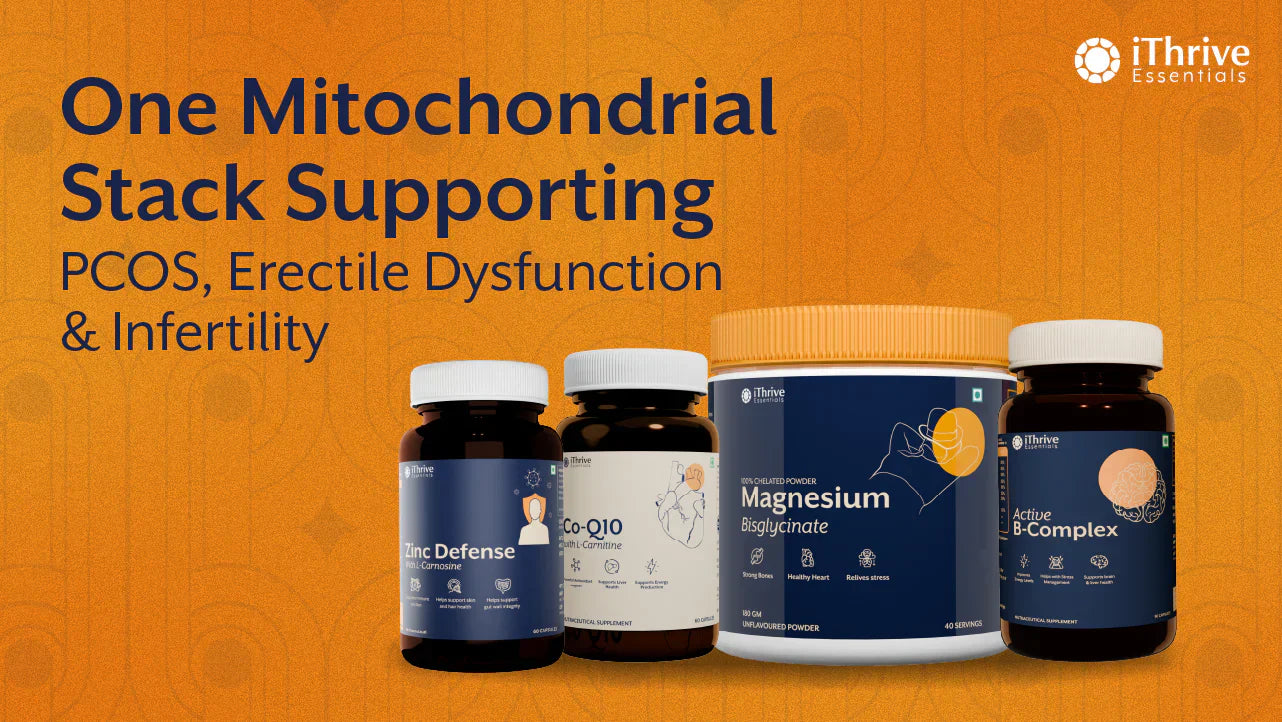
Our formulation philosophy at iThrive essentials integrates this pathway logic, focusing on activated nutrients that operate synergistically rather than in isolation.

Magnesium and Ovarian Relaxation Physiology
Magnesium influences smooth muscle relaxation, cellular signalling, and ATP binding. In ovarian physiology, it modulates enzymatic processes involved in steroidogenesis. Deficiency can contribute to neuromuscular irritability and stress mediated hormonal disruption.
A well formulated magnesium supplement must consider bioavailability. Forms such as magnesium glycinate demonstrate superior absorption compared to poorly absorbed salts. Bioavailability determines biological effect. Potency without absorption is theoretical.
iThrive essentials prioritises pure, potent, proven forms with documented bioavailability rather than generic mineral blends.
Coenzyme Support and Electron Transport Integrity
The electron transport chain is the final stage of ATP production. It depends on riboflavin, niacin derivatives, iron containing complexes, and adequate oxygen utilisation. Impairment at any step reduces ATP yield.
Rather than focusing exclusively on ovarian output, a mitochondria centred PCOS formulation strengthens the entire electron transport system. This improves systemic energy and indirectly enhances reproductive resilience.
The concept of pathway based design versus ingredient stacking is explored further in Why Formulation Quality Determines Biological Impact, where we break down cofactor pairing and activation strategies.
Zinc and Receptor Stability
Hormones communicate through receptors. Receptors require structural integrity to transmit signals effectively. Zinc stabilises receptor proteins and influences gene transcription. Without adequate zinc, signal transmission weakens despite adequate hormone levels.
This reinforces an important clinical reality. Hormone concentration does not equal hormone effectiveness. Cellular responsiveness defines outcome.
What a Truly Mitochondria Targeted PCOS Supplement Should Include
A scientifically designed PCOS supplement should contain:
- Activated B complex with methylated forms
- Choline and TMG for methylation and membrane support
- Bioavailable magnesium
- Selenium and zinc for redox stability
- Potential mitochondrial cofactors such as alpha lipoic acid
It should avoid unnecessary fillers, synthetic inactive forms, and stimulant driven energy enhancers. Sustainable ovarian health requires cellular stability, not artificial metabolic forcing.
iThrive essentials formulations are built around purity, potency, and proven bioavailability. The goal is not short term symptom modulation but long term cellular resilience.

Key Takeaway
Myo inositol remains a valuable tool in PCOS management, but it is only one component of a much larger metabolic network. The ovary depends on mitochondrial efficiency, redox balance, methylation capacity, and receptor stability. Without addressing these foundational systems, supplementation becomes partial rather than comprehensive. A truly mitochondria targeted PCOS supplement integrates activated nutrients, synergistic cofactors, and bioavailable mineral support to restore energy at the cellular level. Sustainable reproductive health begins inside the mitochondria.


Leave a comment
This site is protected by hCaptcha and the hCaptcha Privacy Policy and Terms of Service apply.