
Why Most Thyroid Supplements Fail: A Clinical Comparison of Common Market Formulations vs Precision Nutrient Design
Introduction
The global rise in thyroid dysfunction has created an enormous demand for thyroid supplements. Millions of individuals experiencing thyroid disease symptoms such as fatigue, weight fluctuation, brain fog, hair thinning, and temperature sensitivity search for the best thyroid supplement hoping for metabolic restoration.
Yet clinical reality tells a different story.
Despite widespread supplementation, many individuals continue to experience persistent symptoms even when lab reports show normal thyroid levels. This disconnect has led to growing confusion around thyroid treatment, thyroid hormone function, and the role of nutritional therapy.
The fundamental issue is rarely nutrient absence alone. It is almost always nutrient utilisation failure.
Most market formulations are fundamental issue designed around ingredient inclusion rather than biological activation. They assume that providing iodine or a few minerals automatically restores thyroid physiology. But thyroid hormone production, conversion, transport, receptor sensitivity, and immune regulation are multi - step biochemical processes. Supporting only one step cannot restore a disrupted system.
Precision nutrient design recognises that thyroid physiology operates as an interconnected metabolic network. Supplement effectiveness depends not only on what nutrients are present but on whether they are absorbable, activated, synergistic, and delivered in a biologically usable form.
Understanding why most thyroid supplements fail requires examining how conventional formulations differ from clinically informed, pathway-based designs.
1. The Thyroid Is Not a Single-Nutrient System
Thyroid hormone function depends on coordinated biochemical processes involving nutrient transport, enzyme activation, mitochondrial signalling, and immune regulation.
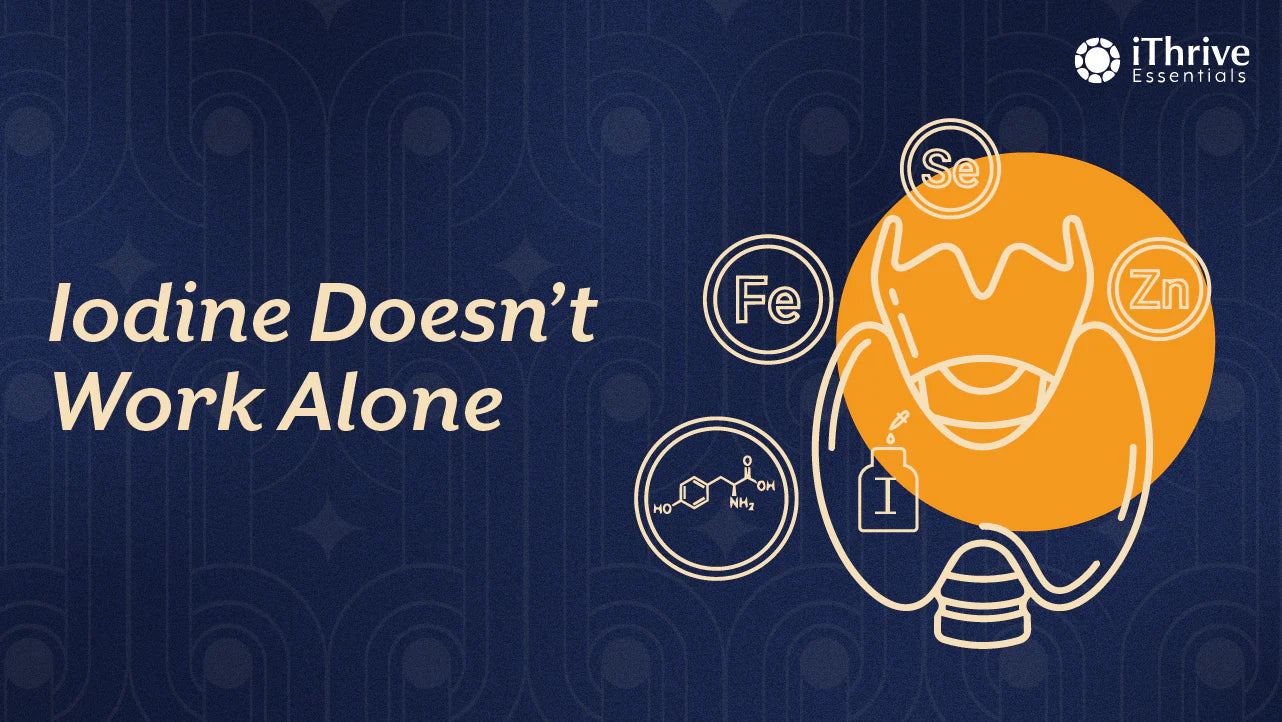
Hormone synthesis requires iodine but hormone activation requires selenium. Hormone sensitivity depends on zinc. Cellular energy metabolism depends on iron and B-vitamins. Autoimmune regulation involves antioxidant and gut-immune interactions.
This complexity explains why thyroid causes rarely involve a single deficiency. Conditions such as hashimoto’s thyroiditis, altered thyroid antibodies, or impaired hormone conversion reflect systemic metabolic dysregulation.
When supplements target only one nutrient, they support only one biochemical step while the remaining system remains dysfunctional.
This is comparable to supplying raw material to a factory without ensuring machinery, energy supply, and quality control are operational.
2. Ingredient Lists Do Not Equal Biological Activity
Most commercial thyroid supplements follow an ingredient-based design philosophy. Their effectiveness is judged by the presence of commonly recognised nutrients rather than metabolic functionality.
Typical market formulations include:
• Iodine in standard forms
• Generic selenium salts
• Non-activated B-vitamins
• Poorly absorbed minerals
• Isolated nutrients without co-factors
From a biochemical standpoint, this approach ignores several critical determinants of nutrient performance:
• Gastrointestinal absorption
• Cellular transport
• Enzyme compatibility
• Oxidative stability
• Co-factor dependency
Nutrients that cannot be absorbed or activated cannot support thyroid treatment regardless of dosage.
This is one of the primary reasons individuals taking thyroid supplements still experience thyroid side effects such as fatigue or metabolic slowing.

3. Hormone Production Is Only the Beginning
Many people assume thyroid dysfunction is simply reduced hormone production. However, hormone synthesis represents only the first stage of thyroid physiology.
Clinical dysfunction often occurs in downstream processes:
• Conversion of T4 into active T3
• Cellular receptor response
• Mitochondrial energy signalling
• Immune-mediated inflammation
• Oxidative stress regulation
When supplements support production without supporting conversion or cellular response, hormone output may increase without functional improvement.
This explains why some individuals experience unchanged symptoms even when thyroid disease symptoms appear controlled biochemically.
4. Autoimmune Activity Is Often Ignored
A large proportion of thyroid disorders involve immune dysregulation rather than simple hormone deficiency.
In hashimoto’s thyroiditis, immune cells attack thyroid tissue, increasing thyroid antibodies and impairing hormone production over time.
Conventional supplements rarely address:
• Oxidative stress in thyroid tissue
• Immune signalling regulation
• Gut-immune interactions
• Antibody modulation
Without addressing these mechanisms, supplementation may support hormone synthesis while autoimmune destruction continues.

5. Bioavailability Determines Clinical Outcome
Bioavailability refers to the proportion of a nutrient that enters circulation and becomes biologically usable.
Two supplements containing identical ingredients may produce dramatically different clinical effects depending on:
• Mineral chelation
• Molecular form
• Transport compatibility
• Oxidation stability
• Delivery system
For example:
• Selenomethionine integrates into metabolic pathways more effectively than inorganic selenium salts
• Methylated B-vitamins bypass conversion barriers
• Chelated minerals improve cellular uptake
Precision formulation focuses on usable nutrient forms rather than ingredient quantity.
This principle is explored in Why We Added Inositol, Choline and TMG to Our New B-Complex Supplement , which explains how activated nutrients directly influence metabolic signalling pathways.
6. Synergy Is Required for Hormonal Stability
Thyroid metabolism is regulated through interconnected enzymatic networks. Enzymes rarely function with single nutrients; they require co-factor combinations.
Examples include:
• Selenium + iodine balance for hormone regulation
• Zinc + vitamin A for receptor function
• Iron + B-vitamins for mitochondrial signalling
Isolated nutrient supplementation can create imbalance if complementary pathways remain unsupported.
Precision formulations therefore focus on pathway integrity, not ingredient presence.
7. Dose Without Context Can Be Counterproductive
High-dose supplementation is often marketed as a marker of effectiveness. However, excessive intake of single nutrients can disrupt metabolic balance.
Examples include:
• Excess iodine increasing oxidative stress in susceptible individuals
• High selenium without antioxidant balance
• Mineral competition affecting absorption
Clinical effectiveness depends on proportional nutrient relationships rather than maximum dosage.
8. Precision Nutrient Design: A Systems-Based Approach
Precision nutrient design recognises thyroid physiology as a network of interdependent biochemical processes.
Effective formulations aim to support:
• Hormone synthesis
• Hormone activation
• Cellular responsiveness
• Oxidative protection
• Immune balance
This requires:
• Activated nutrient forms
• Co-factor pairing
• Targeted delivery
• Clinically informed dosing
This systems-based approach reflects the formulation philosophy behind iThrive Essentials, where supplement design focuses on metabolic usability rather than ingredient presence.

Key Takeaway
Most thyroid supplements fail not because nutrients are unimportant, but because thyroid physiology is far more complex than conventional formulations recognise. Supporting thyroid health requires more than providing iodine or isolated minerals; it demands restoration of an entire metabolic network involving hormone activation, immune regulation, cellular energy signalling, and oxidative balance.
When supplements are designed around ingredients instead of biochemical pathways, they cannot meaningfully influence thyroid hormone function or reduce thyroid antibodies. Precision nutrient design changes this paradigm by focusing on bioavailability, co-factor synergy, and metabolic targeting. True thyroid support is therefore not defined by how many nutrients are included, but by how effectively those nutrients participate in physiological processes. Clinical effectiveness emerges when formulation mirrors biology.


Leave a comment
This site is protected by hCaptcha and the hCaptcha Privacy Policy and Terms of Service apply.