
Article: Marine vs. Flaxseed Omega-3: Why Source Beats Dose
Marine vs. Flaxseed Omega-3: Why Source Beats Dose
By: Mugdha Pradhan
The Omega-3 Mistake Millions of Indians Are Making
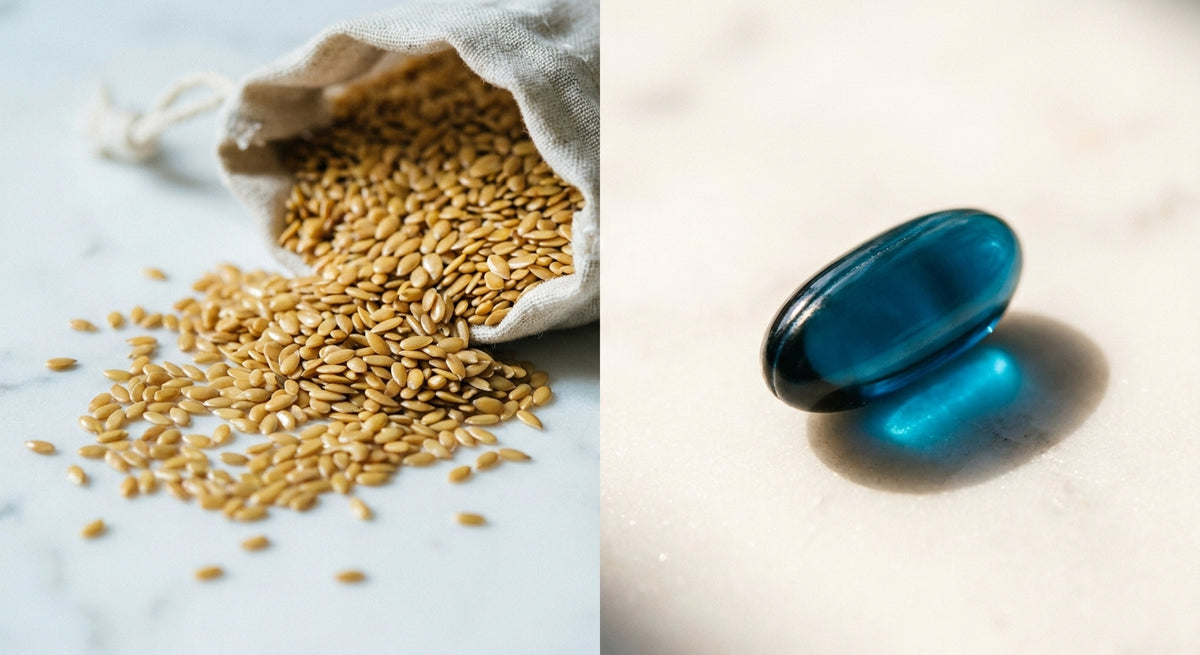
Picture two capsules side by side. Both say 1,000 mg omega-3 on the label. One contains flaxseed oil; the other, fish oil. They look identical. They are not even close to nutritionally equivalent.
The difference comes down to source, and source determines biological outcome far more than milligrams ever will. This matters enormously in India, home to one of the world's largest vegetarian populations, where flaxseed oil has become the default omega-3 supplement. The problem? The plant-based omega-3 in flaxseed oil cannot meaningfully raise the two forms of omega-3 your body actually needs: EPA and DHA.
By the end of this article, you will know exactly what to look for on a label, why it changes everything, and how to verify whether your supplement is actually working.
ALA vs. EPA vs. DHA: Three Omega-3s That Are Not Interchangeable
ALA (alpha-linolenic acid) is the short-chain omega-3 found in flaxseed oil, walnuts, and chia seeds. It is classified as "essential" because the human body lacks the enzymes needed to synthesise it from scratch. You must get it from food. But being essential in your diet does not make it sufficient for your biology.
EPA (eicosapentaenoic acid) is a long-chain marine omega-3 that drives systemic anti-inflammatory pathways. Critically, EPA is a precursor to specialised pro-resolving mediators (SPMs): signalling molecules that do not merely suppress inflammation but actively instruct the immune system to halt the inflammatory response and begin tissue repair. This is a fundamentally different mechanism from simply blocking an inflammatory pathway.
DHA (docosahexaenoic acid) is the structural omega-3 concentrated in brain and retinal membranes. Its unique molecular shape enables the membrane fluidity that neuronal signalling depends on. Without adequate DHA, cellular communication in the brain literally slows down.
Here is the critical point: ALA cannot replicate the SPM-producing or structural functions of EPA and DHA. They are biologically distinct molecules with distinct roles. For anyone dealing with gut disorders, neuroinflammation, hormonal imbalances, or metabolic conditions, the evidence consistently implicates EPA and DHA specifically, not ALA. Treating them as interchangeable is a biochemical error with real health consequences.
The Conversion Problem: Why Flaxseed Oil Cannot Reliably Raise Your EPA or DHA
Your liver can, in theory, convert ALA into EPA and then into DHA. In practice, this pathway is so inefficient that it borders on irrelevant.
Under optimal conditions, ALA-to-EPA conversion sits below 5 to 8%. ALA-to-DHA conversion is far worse: under 0.5 to 4%, with many studies reporting below 1%. One isotope-labelling study tracked the fate of ALA over 12 weeks and found DHA conversion below 0.1%, with combined EPA and DHA conversion under 0.4%. These are not rounding errors. They represent a near-complete failure of the conversion pathway.
The enzymatic bottleneck is real. The liver's conversion machinery is slow, rate-limited, and shared with competing substrates. It simply cannot process ALA into meaningful quantities of long-chain omega-3s.
Layer on the Indian dietary context, and the picture gets worse. Diets heavy in refined sunflower oil and soybean oil create an omega-6 overload that directly competes with ALA for the same enzymes. Research shows that high omega-6 intake suppresses ALA-to-EPA/DHA conversion by 40 to 50%. In a country where these refined oils dominate home cooking and packaged food, flaxseed oil supplementation becomes even less effective than the already-dismal global averages suggest.
The data from Indian populations confirms this. A 2025 study comparing pregnant women in Bengaluru with Australian women found that Indian participants had total n-3 values of just 2.01 to 2.36% of total fatty acids, compared to 4.75% in Australians. Both vegetarian and omnivore Indian women were deficient. ALA, EPA, and DHA were all less than half the Australian values.
Consider the dietary reality: vegetarian diets that include dairy and eggs provide only about 0.02 g of DHA per day. Vegan diets are essentially devoid of it.
This brings us to the dose illusion. A 1,000 mg flaxseed oil capsule, after accounting for ALA content and the conversion bottleneck, may yield less than 10 mg of usable DHA. The number on the label is almost meaningless. Source is everything.
Why Marine Omega-3 Delivers What Flaxseed Oil Cannot
Fish oil and algal oil deliver EPA and DHA in their pre-formed, ready-to-use state. They are absorbed directly into the bloodstream at approximately 90 to 100% efficiency, bypassing the liver's conversion bottleneck entirely. No enzymatic competition. No 0.1% trickle. Direct delivery.
The clinical data reflects this difference starkly. Fish and algae-based EPA+DHA supplementation raises plasma omega-3 levels by 10 to 300% within 6 to 14 weeks. ALA supplementation, by contrast, produces no significant rise in the Omega-3 Index.
The Omega-3 Index itself is worth understanding. It measures EPA+DHA as a percentage of red blood cell fatty acids and has emerged as a clinically validated, testable biomarker of cardiometabolic risk. An index below 4% signals very high cardiovascular risk. Above 8% is considered cardioprotective.
The cardiovascular risk data is compelling. Each 1% increase in the Omega-3 Index is associated with roughly a 9% reduction in coronary heart disease mortality. An index of 8% versus 4% is linked to a 30% reduced risk of fatal CHD. Higher EPA+DHA erythrocyte levels are associated with a 45% reduction in sudden cardiac death risk.
Beyond the heart, cognitive benefits are significant. In adults with coronary artery disease, 3.36 g of EPA and DHA daily was associated with slowing cognitive ageing by approximately 2.5 years.
For those looking to actually move their Omega-3 Index with a clinically dosed, filler-free formulation, iThrive's Marine Omega-3 Complex (Krill Oil + Fish Oil, 90 Soft Gels) combines two marine sources to deliver pre-formed EPA and DHA, designed to produce a measurable outcome rather than a label claim.
The Vegan and Vegetarian Solution: Algal Oil
Here is the paradox facing Indian vegetarians: flaxseed oil is the default omega-3 choice, yet it cannot meaningfully raise EPA or DHA. The result is a silent, widespread deficiency with direct implications for heart, brain, and metabolic health.
Microalgal oil resolves this. Fish obtain their EPA and DHA from algae in the first place, so algal oil goes directly to the original source. A 2025 randomised controlled trial involving 74 adults over 14 weeks found that microalgal DHA/EPA was non-inferior to fish oil in raising plasma phospholipid levels (geometric mean ratio of 111%, with a 94 to 132% confidence interval).
Algal oil is sustainable, vegetarian-friendly, and clinically validated. It represents a gap most Indian supplement brands have not yet addressed, despite the massive population that needs it.
How to Read an Omega-3 Label and Spot a Supplement That Won't Work
The single most important number on any omega-3 label is the combined EPA+DHA content per serving. Not "total fish oil." Not "total omega-3." The actual milligrams of EPA and DHA combined. If this number is not listed explicitly, that is a red flag.
A 1,000 mg fish oil capsule can contain as little as 180 mg EPA plus 120 mg DHA if it uses a low-concentration oil. That is 300 mg of active omega-3 from a capsule that appears to deliver 1,000 mg. The clinically effective threshold for most benefits sits between 500 and 1,000 mg of combined EPA+DHA per day. Low-concentration products force you to take three or four capsules to reach that range.
Oxidation and rancidity matter. Rancid fish oil does not just lose efficacy; it may actively cause harm through oxidised lipid byproducts. Open a capsule and smell it. It should have a fresh, neutral, mildly oceanic scent. A strong fishy or sour odour indicates oxidation. Look for products stabilised with antioxidants like vitamin E or astaxanthin.
One common objection: women of reproductive age convert ALA to EPA at roughly 2 to 2.5 times the rate of men, thanks to oestrogen's influence on the conversion enzymes. This sounds promising until you look at the absolute numbers. Even this elevated rate is insufficient to meaningfully raise DHA levels from ALA supplementation alone. The source rule applies to everyone.
The Omega-3 Index is the only way to verify whether your current supplement is actually working. Supplementation should produce a measurable outcome, not a guessing game.
The Bottom Line: Test Your Index, Choose Your Source
Source determines whether your omega-3 supplement actually raises EPA and DHA in your blood. The dose printed on the label is secondary. A 1,000 mg flaxseed oil capsule and a properly formulated marine omega-3 capsule occupy entirely different biological categories.
For most Indian adults, this is urgent. High omega-6 diets driven by refined cooking oils, widespread vegetarianism, and documented low baseline n-3 levels create a compounding omega-3 insufficiency. Marine-source EPA+DHA, from fish oil, krill oil, or algal oil, is not optional. It is a priority.
The path forward is straightforward: get your Omega-3 Index tested, switch to a marine-source EPA+DHA supplement, and track your results over 8 to 12 weeks. Treat supplementation as a measurable health outcome, not a checkbox.
Clinical-grade supplementation means choosing what the evidence supports, not what the label makes sound impressive. That principle, backed by over a decade of functional health practice and more than 6,000 health journeys, is what drives every formulation decision at iThrive.


Leave a comment
This site is protected by hCaptcha and the hCaptcha Privacy Policy and Terms of Service apply.